The Long Put Strategy in options trading is used when a trader expects NIFTY to move lower within a specific time period. It is one of the cleanest ways to trade bearish views because the risk is strictly limited while the profit potential increases as the market falls. Despite this, many traders misuse long puts by entering too late or holding them emotionally, which leads to unnecessary losses.
This guide explains the long put strategy exactly as it should be understood by a NIFTY trader, with clear logic, practical usage, and realistic expectations.
What Is the Long Put Strategy
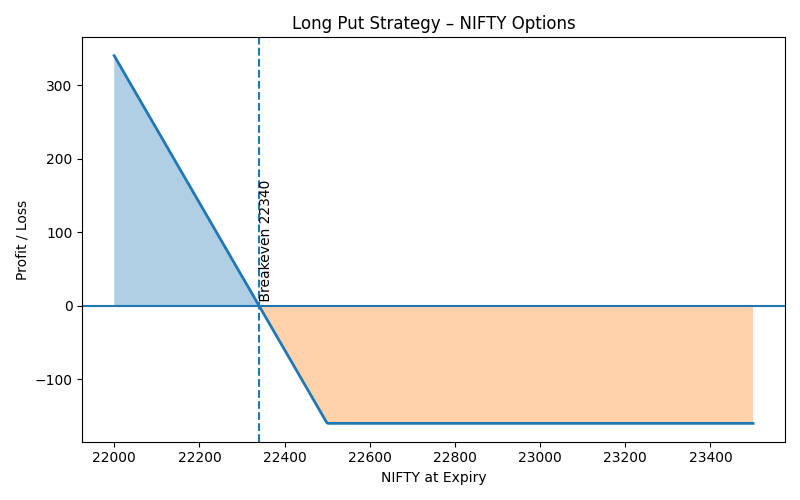
A long put strategy involves buying a put option when you expect NIFTY to decline.
When you buy a put option
• You gain when NIFTY moves down
• Your maximum loss is limited to the premium paid
• Your profit increases as the market falls
This strategy benefits from bearish momentum and works best when selling pressure builds steadily rather than suddenly.
Why Traders Use the Long Put Strategy
Traders use long puts because
• Risk is predefined and controlled
• Capital requirement is lower than futures
• It provides direct exposure to downside moves
• It reacts quickly during breakdowns
Long puts are especially useful during market weakness, news-driven selling, or breakdowns from important support levels.
When the Long Put Strategy Works Best
The long put strategy performs best under specific conditions.
Use a long put when
• NIFTY breaks below a clear support level
• Price closes below support, not just dips
• Selling pressure increases across sectors
• The trade is initiated early in the breakdown
The best long put trades usually occur after a failed bounce, not during panic selling.
When You Should Avoid Buying Puts
Avoid long puts when
• NIFTY is already deeply oversold
• Selling looks emotional or news-driven
• Strong support lies just below current price
• Expiry day is near and movement has slowed
Buying puts after panic selling often results in fast premium decay due to sudden bounces.
Strike Price Selection for NIFTY Puts
Strike selection is critical in put buying.
For most traders
• Prefer ATM or slightly ITM puts
• Avoid far OTM puts that look cheap
Cheap puts require aggressive selling to become profitable. ATM puts respond better to price movement and offer more control.
Example of a Long Put Trade in NIFTY
Assume
NIFTY is trading near 22,300
Support at 22,280 breaks decisively
A 15-minute candle closes below support
Trade setup
Buy 22,300 Put
Premium ₹140
Lot size 50
Total risk ₹7,000
Your loss is fixed at entry. Fear is reduced.
Profit and Loss Structure Explained Simply
If NIFTY falls sharply
• Put premium expands quickly
• Profits build faster than in slow moves
If NIFTY stalls or bounces
• Put premium collapses rapidly
• Time decay accelerates
This is why long puts must be managed actively.
Impact of Time Decay on Long Puts
Time decay affects puts just like calls.
In weekly NIFTY options
• Decay increases after Tuesday
• Rapid premium erosion happens during consolidation
• Expiry day decay is extremely aggressive
Rule to remember
When selling pressure stops, exit the put.
Expiry Week Behavior You Must Understand
During expiry week
• Downside moves are fast but short-lived
• Bounces are sharp and sudden
• Option writers quickly reduce put premiums
Holding puts into expiry without momentum usually leads to losses.
Risk Management Rules for Long Put Strategy
Follow these rules strictly
• Risk only a small portion of your capital
• Never average losing puts
• Exit if NIFTY reclaims broken support
• Book profits quickly on sharp falls
Downside trades reward speed, not patience.
Common Mistakes Beginners Make
• Buying puts after large red candles
• Trading puts due to fear or news
• Holding losing puts hoping for a crash
• Ignoring bounce zones and support levels
Most put buyers lose money not because the market goes up, but because it stops going down.
Psychology Behind Successful Put Buying
Successful put buyers
• Stay calm during red candles
• Enter with structure, not emotion
• Exit quickly when momentum fades
Unsuccessful traders panic early and hesitate late.
Long Put Strategy Summary
Quick Overview
Market view: Bearish
Risk: Limited to premium paid
Reward: High on downside
Best used: Support breakdowns with momentum
Worst used: After panic selling or near expiry
The long put strategy is effective only when used selectively. One well-timed trade is better than multiple emotional entries.
Final Thought
The long put strategy is not about predicting crashes.
It is about capturing controlled downside moves.
If you respect support levels, manage time decay, and act decisively, long puts can become a powerful part of your NIFTY options trading approach.
Used emotionally, they become expensive very quickly.
Trade structure, not fear.