The Call Ratio Spread is an advanced options strategy used when a trader expects NIFTY to move slightly higher but not explode into a strong bullish trend. Unlike simple call buying or spreads, this strategy is designed to benefit from limited upside and time decay, while accepting higher risk if the market moves aggressively.
This strategy rewards precision and discipline. It punishes overconfidence.
What Is the Call Ratio Spread
A Call Ratio Spread involves:
• Buying one call option at a lower strike
• Selling two call options at a higher strike
• All options have the same expiry
Most commonly, this is done in a 1:2 ratio. The extra short call helps reduce or eliminate cost, but it also introduces unlimited risk on the upside.
Why Traders Use Call Ratio Spreads
Traders use this strategy because:
• Entry cost is low or even zero
• It benefits from mild upside movement
• Time decay works in your favor near the sold strike
• It performs well near resistance zones
This strategy is often used by experienced traders around weekly NIFTY expiries.
When the Call Ratio Spread Works Best
This strategy performs best when:
• NIFTY is mildly bullish
• Price is approaching a strong resistance
• Volatility is expected to fall
• No breakout is expected
The ideal scenario is slow upward movement followed by consolidation.
When You Should Avoid Call Ratio Spreads
Avoid this strategy when:
• A strong bullish breakout is expected
• Momentum is accelerating
• Events or news can trigger sharp rallies
• You are not monitoring positions actively
A trending market can cause rapid losses in this setup.
Strike Selection Logic for NIFTY
Strike selection is critical.
General guideline:
• Buy ATM or slightly ITM call
• Sell OTM calls near resistance
• Keep enough distance between strikes
The sold strike defines where maximum profit occurs and where risk begins.
Example of a Call Ratio Spread in NIFTY
Assume:
NIFTY trading at 22,600
Trade setup:
Buy 22,500 Call at ₹180
Sell 23,000 Call × 2 at ₹90
Net cost ≈ Zero
Lot size 50
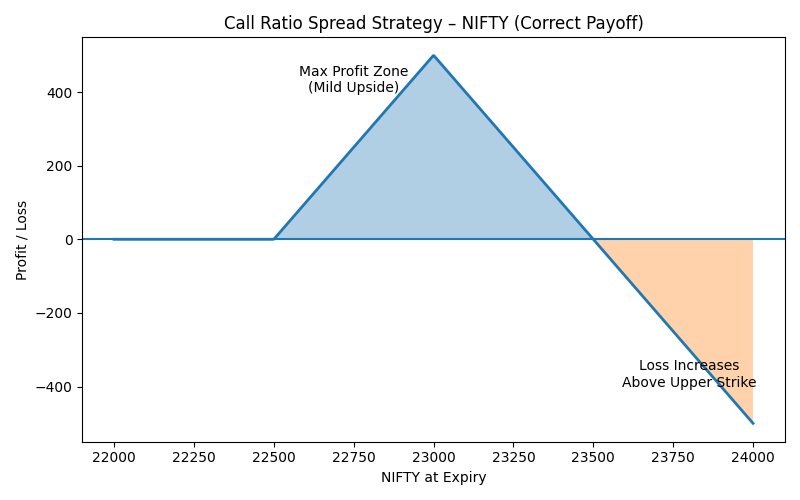
This setup benefits if NIFTY stays near 23,000 at expiry.
Profit and Loss Structure Explained Simply
• Maximum profit occurs near the sold call strike
• Profit zone exists between the two strikes
• Loss increases if NIFTY moves sharply above the sold strike
• Downside risk is limited
This asymmetric payoff makes management essential.
Impact of Time Decay on Call Ratio Spreads
Time decay is a major advantage.
• Sold calls decay faster
• Flat markets benefit the strategy
• Late expiry works in favor if price stays controlled
This is why traders prefer this strategy closer to expiry.
Expiry Week Behavior You Must Understand
During expiry week:
• Mild moves generate profit
• Sudden rallies are dangerous
• Late adjustments become difficult
Active monitoring is mandatory.
Risk Management Rules for Call Ratio Spread
Follow these rules strictly:
• Never ignore upside risk
• Exit or hedge if resistance breaks
• Avoid oversized positions
• Accept small losses early
This strategy is not suitable for passive traders.
Common Beginner Mistakes
• Using this strategy in trending markets
• Selling calls too close to ATM
• Ignoring upside risk
• Treating it as a free trade
There is no free trade in options.
Call Ratio Spread Strategy Summary
Quick Overview
Market view: Mild bullish to sideways
Risk: Unlimited on upside
Reward: Moderate
Best used: Near resistance, low volatility
Worst used: Strong bullish trends
This strategy suits experienced traders only.
Final Thought
The Call Ratio Spread is a precision strategy. When used correctly, it can generate consistent returns with minimal cost. When used carelessly, it can cause sharp losses.
In options trading, knowing when not to trade a strategy is the real edge.