
If you observe NIFTY closely over time, you will notice one important truth.
It does not move randomly.
It moves in phases.
Every major rally, every sharp fall, every frustrating sideways market follows a repeatable structure. Institutions understand this structure very well. Retail traders usually do not. That gap in understanding is why most traders feel confused while price seems perfectly logical in hindsight.
To trade NIFTY with consistency, you must first understand how it behaves during accumulation, markup, distribution, and markdown. Once you learn this, price action starts making sense. Volatility stops feeling random. Even losing days begin to feel educational instead of emotional.
This article breaks down each phase clearly using real NIFTY behavior seen repeatedly in Indian markets.
The Four Phases of NIFTY Movement
NIFTY does not go straight up or straight down. It rotates through four phases:
Accumulation
Markup
Distribution
Markdown
Each phase has a distinct price behavior, volatility profile, option behavior, and participation pattern. Missing the phase is what causes wrong strategy selection.
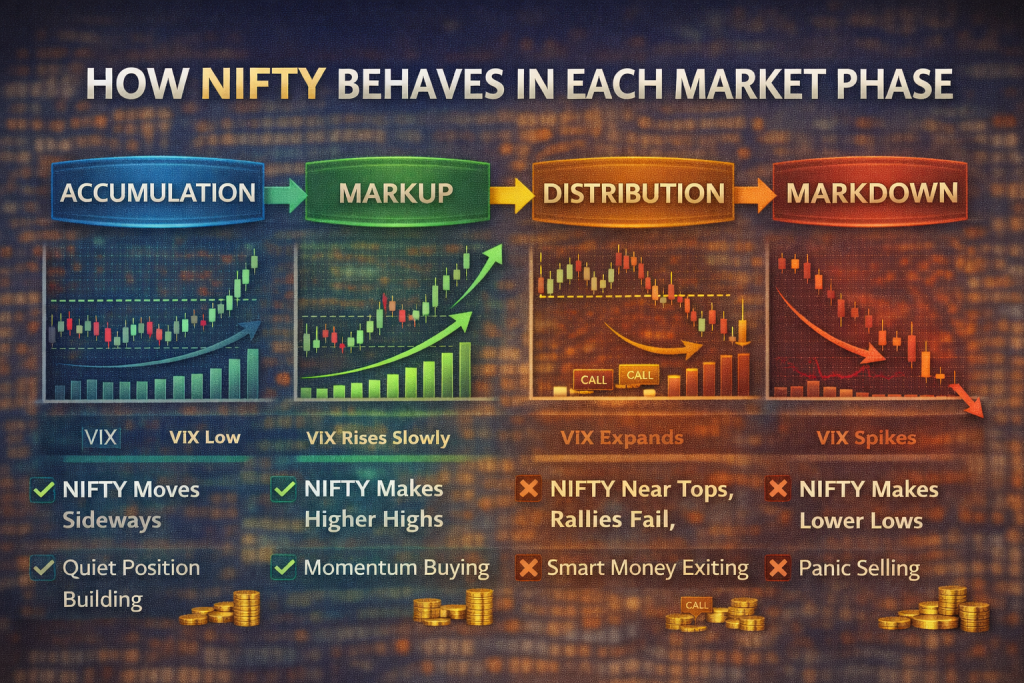
Let us understand them one by one.
Accumulation Phase in NIFTY
How This Phase Begins
Accumulation usually starts after a prolonged fall or a sharp correction. Sentiment is weak. News is negative. Retail participation is low. Most traders have either lost money or stepped aside.
This is where institutions quietly start building positions.
How NIFTY Price Behaves
NIFTY moves sideways in a narrow range.
Breakouts fail quickly.
Breakdowns also fail.
Price keeps returning to a value area.
You will often hear traders complain that the market is boring or dead during this phase. That boredom is not accidental. It is intentional.
Institutions want liquidity without attracting attention.
Volume and Volatility Behavior
Volume remains steady but not explosive.
Volatility contracts.
India VIX stays subdued.
Options premiums decay slowly. Big one-directional moves are absent.
What Retail Traders Usually Do Here
Retail traders overtrade.
They chase false breakouts.
They buy options expecting a big move that never comes.
As a result, option buyers slowly bleed premium while institutions continue accumulating futures and stocks quietly.
What Actually Works in This Phase
Selling option premium with protection.
Range-based strategies.
Patience over prediction.
Accumulation is not about direction. It is about preparation.
Markup Phase in NIFTY
How Markup Begins
Markup begins when accumulation is complete and supply dries up. One strong move breaks the range with follow-through. Dips start getting bought aggressively.
This is where trend followers feel alive again.
How NIFTY Price Behaves
Higher highs and higher lows form clearly.
Pullbacks are shallow.
Intraday dips reverse quickly.
Breakouts hold instead of failing.
This phase often feels “easy” because price respects levels cleanly.
Volume and Volatility Behavior
Volume expands on up moves.
Volatility increases gradually but remains controlled.
India VIX rises slowly.
Options premiums expand. Delta trades begin working well.
What Retail Traders Usually Do Here
Retail traders gain confidence.
They increase position size.
They start believing the market will go up forever.
This is also where social media turns bullish.
What Actually Works in This Phase
Futures with trailing risk.
Directional option spreads.
Buying dips instead of breakouts.
Markup rewards discipline, not excitement.
Distribution Phase in NIFTY
How Distribution Begins
Distribution starts near market highs. News remains positive. Results are good. Everyone is bullish.
Institutions do not exit aggressively. They distribute slowly.
How NIFTY Price Behaves
NIFTY becomes volatile near highs.
Rallies fail to extend.
Sharp intraday reversals increase.
The index may make marginal new highs, but internally strength weakens.
Volume and Volatility Behavior
Volume spikes on up moves and down moves.
Volatility expands.
India VIX starts rising without obvious fear.
Options premiums inflate.
What Retail Traders Usually Do Here
Retail traders buy breakouts aggressively.
They hold losing long positions hoping for continuation.
They start blaming manipulation.
In reality, they are providing exit liquidity.
What Actually Works in This Phase
Reducing long exposure.
Neutral option selling with defined risk.
Focusing on risk management instead of profits.
Distribution is where smart money exits quietly.
Markdown Phase in NIFTY
How Markdown Begins
Markdown starts when distribution is complete and support breaks decisively. News suddenly turns negative. Panic replaces optimism.
The fall often feels fast and emotional.
How NIFTY Price Behaves
Lower highs and lower lows form.
Bounces are weak and short-lived.
Intraday volatility becomes extreme.
Stops get hit frequently.
Volume and Volatility Behavior
Volume surges.
India VIX spikes sharply.
Options premiums explode.
Fear dominates decision making.
What Retail Traders Usually Do Here
Retail traders panic sell at lows.
They buy puts after large falls.
They exit positions emotionally.
This is where maximum losses happen for undisciplined traders.
What Actually Works in This Phase
Protective option structures.
Short rallies, not breakdowns.
Capital preservation over aggressive trading.
Markdown punishes hope and rewards preparation.
Why Most Traders Fail to Read the Phase
Most traders focus on indicators instead of context.
They ask “Is RSI oversold?” instead of “Which phase are we in?”
They trade the same strategy in every environment.
NIFTY does not reward fixed strategies.
It rewards phase awareness.
How Institutions Use Phase Behavior to Their Advantage
Institutions align strategies with phases.
Accumulation phase: build quietly
Markup phase: ride trend
Distribution phase: exit smartly
Markdown phase: protect capital or short selectively
They are never confused because they are never emotional.
How You Should Use This Knowledge as a Trader
Before taking any trade, ask one question.
Which phase is NIFTY currently in?
That single question filters bad trades automatically.
It improves option strategy selection.
It improves position sizing.
It improves patience.
You do not need to predict tops or bottoms.
You only need to align with the phase.
Final Thoughts
NIFTY is not chaotic.
It is structured.
It repeats behavior because human psychology repeats.
Once you stop reacting to candles and start reading phases, trading becomes calmer. Losses reduce. Decisions improve.
Most traders look for indicators.
Professionals look for context.
If you want to trade NIFTY seriously, phase awareness is not optional. It is foundational.
That single shift in perspective separates traders who survive from those who keep restarting their journey every year.