The Covered Call Strategy is not designed for aggressive trading or fast profits. It is built for traders and investors who already hold NIFTY exposure and want to generate regular income from the market without increasing risk unnecessarily. This strategy is widely used by professional investors to monetize sideways markets where price movement is limited.
Covered calls reward patience, not prediction.
What Is the Covered Call Strategy
A covered call strategy involves two positions:
• Holding NIFTY or a NIFTY ETF position
• Selling a call option against that holding
Because the call is sold against an existing position, the risk of selling the call is “covered”. This is why the strategy is considered safer than naked call selling.
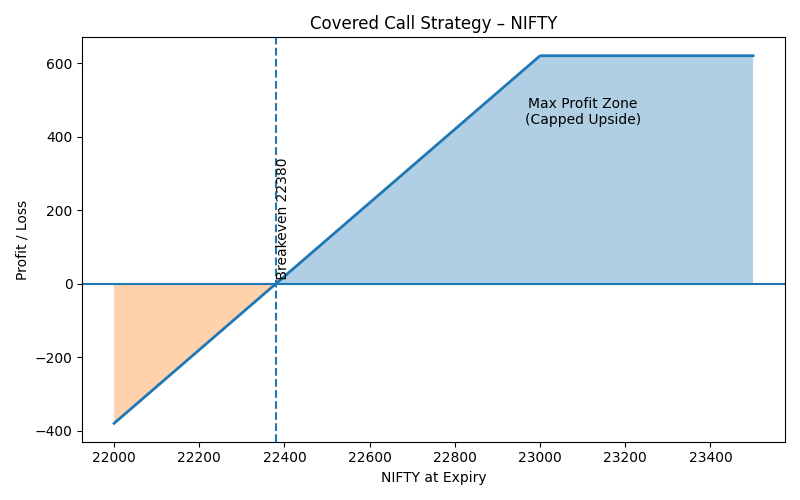
This image is not accurate because it’s a hybrid strategy you will sell call options to gain premium and you will buy the asset (NIFTY ETF/NIFTY FUT) in case Nifty gives a big upside move.
Why Traders and Investors Use Covered Calls
The covered call strategy is popular because:
• It generates regular premium income
• It reduces downside risk slightly through premium received
• It works well in sideways markets
• It requires less frequent decision making
This strategy is more about income and stability than capital appreciation.
When the Covered Call Strategy Works Best
Covered calls work best when:
• NIFTY is range-bound
• Market is mildly bullish but not trending strongly
• Clear resistance is visible above current price
• Volatility is moderate
In such conditions, the sold call option decays and the trader keeps the premium.
When You Should Avoid Covered Calls
Avoid covered calls when:
• NIFTY is breaking out strongly
• A trending rally is expected
• Volatility is expanding aggressively
• Major bullish events are approaching
In strong bullish markets, covered calls cap upside and reduce opportunity.
Strike Selection Logic for NIFTY
Strike selection decides income and opportunity cost.
General guideline:
• Sell calls slightly above resistance
• Avoid selling very close ATM calls
• Accept lower premium for safety
Higher strikes give safety but less income. Lower strikes give income but cap upside quickly.
Example of a Covered Call Trade in NIFTY
Assume:
NIFTY trading at 22,500
You hold NIFTY ETF or equivalent position
Trade setup:
Sell 23,000 Call
Premium received ₹120
Lot size equivalent to position
If NIFTY stays below 23,000, you keep the full premium.
Profit and Loss Structure Explained Simply
• Maximum profit is capped
• Profit comes from premium + limited price movement
• Downside loss still exists if NIFTY falls sharply
• Breakeven is lower than spot due to premium received
This makes the strategy conservative, not risk-free.
Impact of Time Decay on Covered Calls
Time decay works in your favour.
• Sold call loses value every day
• Sideways price action benefits the strategy
• Faster decay near expiry increases income probability
This is why covered calls are popular in weekly and monthly options.
Expiry Week Behavior You Must Understand
During expiry week:
• Slow price action benefits the seller
• Sharp late moves can threaten the strike
• Premium erosion accelerates rapidly
Covered calls should ideally be set before expiry week begins.
Risk Management Rules for Covered Call Strategy
Follow these rules strictly:
• Do not sell calls during strong uptrends
• Be comfortable with capped upside
• Roll the call only if it fits your plan
• Never panic-close without reason
This strategy rewards calm behaviour.
Common Beginner Mistakes
• Selling calls too close to market price
• Using covered calls during breakouts
• Panicking on small upside moves
• Expecting unlimited profit
Covered calls trade excitement for consistency.
Covered Call Strategy Summary
Quick Overview
Market view: Sideways to mildly bullish
Risk: Downside risk exists
Reward: Capped
Best used: Range-bound markets
Worst used: Strong bullish trends
This strategy suits investors who value income over speculation.
Final Thought
The Covered Call Strategy is not about timing the market.
It is about letting time work for you.
Used correctly, it reduces portfolio volatility and adds steady income. Used incorrectly, it limits opportunity. Understanding market context is everything.