
Understanding the Invisible Phases That Control Market Direction
Most traders look at NIFTY as a moving number on the screen. Green candle means strength. Red candle means weakness. Breakout means buy. Breakdown means sell. But that surface level view hides the most important truth about how markets actually move.
NIFTY does not trend randomly. It does not reverse because of indicators. It moves because large participants go through very deliberate phases of accumulation and distribution.
If you understand these phases, you stop reacting to price and start reading intent. That single shift alone puts you ahead of the majority of retail traders.
This article explains how NIFTY is accumulated and distributed in real Indian market conditions and how institutions quietly position themselves long before the obvious move happens.
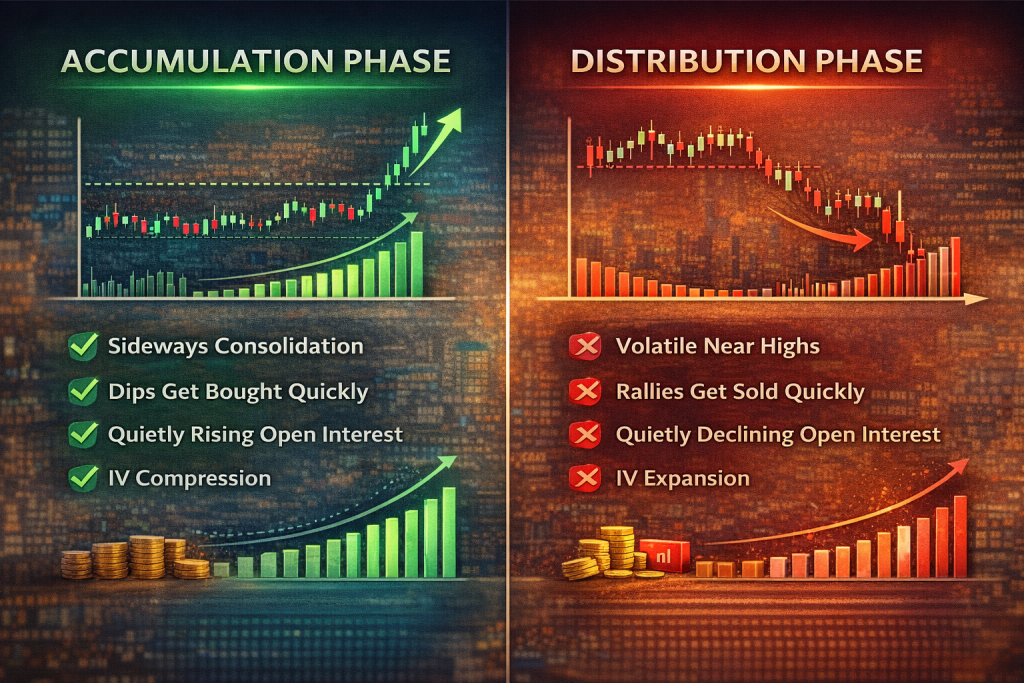
What Accumulation and Distribution Really Mean in NIFTY
Accumulation and distribution are not patterns on a chart. They are processes.
Accumulation is the phase where big players build long exposure in NIFTY without letting the price run away.
Distribution is the phase where they reduce or exit long exposure or build short exposure without triggering panic.
Because NIFTY represents the top weighted Indian stocks, institutions cannot enter or exit in one shot. Their size is too large. They need time, liquidity, and patience.
That is why NIFTY spends more time moving sideways than trending.
Sideways movement is not inactivity. It is preparation.
Why NIFTY Is the Perfect Instrument for Accumulation
NIFTY is extremely liquid. Futures, options, ETFs, and cash market activity all converge here.
This liquidity allows institutions to transact massive volumes without leaving obvious footprints.
A fund that wants exposure worth thousands of crores does not chase breakouts. It accumulates during boredom.
That is why the most aggressive accumulation happens when retail traders lose interest.
Low volatility
Repeated range trading
Sharp intraday reversals
Failed breakouts and breakdowns
These are not random. They are symptoms of accumulation.
How Accumulation in NIFTY Actually Happens
Step One: Volatility Compression
Before accumulation begins, volatility usually contracts.
NIFTY stops trending and enters a tight range. Every breakout attempt fails. Every breakdown gets bought back.
This frustrates retail traders, especially option buyers.
But this environment is ideal for institutions. Low volatility allows them to buy futures, sell puts, hedge with calls, and quietly increase net long exposure.
Step Two: Support Creation Without Obvious Strength
During accumulation, NIFTY refuses to fall despite bad news or global weakness.
Dips get bought quickly
Intraday sell offs recover
Closing prices stay stable
This is not strength yet. It is absorption.
Sell orders from retail and weak hands are being absorbed by stronger participants.
Step Three: Option Market Confirmation
In NIFTY options, accumulation often shows up as:
Put writing increasing at key strikes
IV staying elevated on puts
Call writers becoming defensive
This tells you that downside is being protected, not attacked.
Institutions often use short puts and bull spreads to synthetically build long exposure without pushing futures aggressively.
Step Four: Final Shakeout
Before the actual up move, NIFTY often does one last shakeout.
A sudden fall
A scary news candle
A breakdown below range
This move forces remaining weak longs to exit. Liquidity increases. Institutions use this liquidity to complete accumulation.
Only after this phase does the real trend begin.
How Distribution in NIFTY Takes Place
Distribution is more deceptive than accumulation.
Price is usually higher. News is positive. Retail confidence is strong.
That is exactly why distribution works.
Step One: Slowing Momentum Near Highs
NIFTY makes higher highs but struggles to follow through.
Strong opens fade
Rallies fail to expand
Volume increases without price movement
This is not consolidation. It is unloading.
Institutions are selling into strength while retail is buying breakouts.
Step Two: Heavy Call Writing and Hedging
In options, distribution shows up as:
Aggressive call writing at higher strikes
Put buying instead of put writing
IV rising despite flat price
This means protection is being built on the downside while upside is capped.
Smart money is no longer interested in pushing price higher.
Step Three: News Based Traps
Distribution often aligns with positive headlines.
Index inclusion
GDP optimism
Global cues turning positive
These stories attract late buyers.
Institutions do not sell in panic. They sell into optimism.
Step Four: Breakdown After Distribution Completes
Once distribution is complete, NIFTY no longer holds support.
Dips stop getting bought
Recoveries become weak
Volatility expands
At this stage, retail is still bullish but liquidity support is gone.
That is when real declines begin.
Why Retail Usually Misses Accumulation and Distribution
Retail traders focus on direction. Institutions focus on positioning.
Retail looks for patterns. Institutions create environments.
Retail buys breakouts. Institutions sell breakouts during distribution.
Retail panics during ranges. Institutions accumulate during ranges.
That is why most retail traders enter at the end of moves and exit at the beginning of reversals.
How You Can Identify Accumulation and Distribution as a Trader
You do not need advanced tools. You need observation.
Watch how NIFTY behaves around key levels.
Ask simple questions.
Does price respect bad news or ignore it
Do dips recover faster than rallies extend
Is option data supporting direction or contradicting it
Is volatility expanding or compressing
Markets always speak before they move. Most traders just do not listen.
The Role of NIFTY Weightage in These Phases
Accumulation and distribution often occur through heavyweight stocks.
Banks, IT majors, Reliance, and FMCG stocks are rotated one by one.
NIFTY stays flat while internal rotation hides real positioning.
By the time all weights align, the move becomes obvious to everyone.
That is when risk actually increases.
Why Understanding These Phases Changes Your Trading
Once you understand accumulation and distribution:
You stop chasing breakouts
You stop fearing sideways markets
You align trades with structure, not noise
You reduce overtrading dramatically
Most importantly, you stop providing liquidity at the wrong time.
NIFTY rewards patience, not prediction.
practical trading framework built specifically for NIFTY futures and options, derived from accumulation and distribution behaviour.
This is not theory. This is a usable decision model you can follow daily.
The Core Idea Behind the Framework
NIFTY does not move randomly.
It rotates through three repeatable phases driven by institutions.
- Accumulation
- Expansion
- Distribution
Retail usually trades the expansion emotionally.
Institutions make money in accumulation and distribution.
This framework helps you identify the phase early and choose the correct instrument and strategy.
Step 1: Identify the Market Phase on NIFTY
Before placing any trade, your only job is to answer one question.
Is NIFTY being accumulated or distributed right now?
Accumulation Phase Characteristics
Price behaviour
NIFTY moves sideways in a narrow range
Dips are bought quickly
No follow through on breakdowns
Options behaviour
Implied volatility compresses
Premiums decay slowly
Put writing and call writing both visible
Data clues
Open interest increases without price movement
PCR remains stable or slowly rises
Futures basis stays positive or flat
This phase usually happens after a correction or long consolidation.
Distribution Phase Characteristics
Price behaviour
NIFTY struggles near highs
Rallies fail quickly
Range becomes wider and volatile
Options behaviour
Implied volatility expands
Sudden premium spikes
Heavy call writing at higher strikes
Data clues
Open interest shifts from puts to calls
PCR starts falling
Futures show aggressive short build up
This phase usually happens after a strong rally.
Step 2: Choose the Right Instrument for Each Phase
This is where most retail traders fail.
They use the same instrument in every phase.
During Accumulation
Best instruments
NIFTY options
Short volatility strategies
Limited risk structures
Avoid
Aggressive option buying
High leverage futures
Why
Institutions are building positions quietly.
They want time, not speed.
During Expansion
Best instruments
NIFTY futures
Directional option spreads
Debit strategies
Avoid
Naked option selling
Complex hedges
Why
This is when price moves fast.
Direction matters more than theta.
During Distribution
Best instruments
Option selling with protection
Bearish spreads
Short futures with tight risk
Avoid
Late breakout buying
Weekly option buying
Why
Institutions are offloading risk.
Retail becomes exit liquidity here.
Step 3: Strategy Playbook for Each Phase
Accumulation Phase Strategy Set
NIFTY options framework
Short strangle with wide wings
Iron condor with adjustment rules
Calendar spreads near ATM
Rules
Trade small size
Give time for decay
Exit if IV expands suddenly
Objective
Earn from time and stability.
Expansion Phase Strategy Set
NIFTY futures framework
Trade pullbacks, not breakouts
Use VWAP or previous day high low
Partial booking mandatory
Options framework
ATM debit spreads
Directional calendars
Limited risk ratio spreads
Rules
Follow price, not indicators
Trail aggressively
Do not overstay
Objective
Capture directional momentum.
Distribution Phase Strategy Set
NIFTY options framework
Call credit spreads
Broken wing butterflies
Bearish iron condors
NIFTY futures framework
Short near resistance zones
Scale out quickly
Avoid overnight risk
Rules
Protect downside always
Book profits early
Expect sudden reversals
Objective
Benefit from volatility and failed rallies.
Step 4: Daily Execution Checklist
Before every NIFTY trade, run this checklist.
- Is price expanding or compressing
- Is open interest rising with price or against it
- Is IV increasing or decreasing
- Are options premiums behaving logically
- Which participant benefits if price stays here
If you cannot answer these five points, you should not trade.
Step 5: Common Retail Mistakes This Framework Avoids
Buying options during accumulation
Selling options during expansion
Chasing breakouts during distribution
Trading direction when institutions want time
Ignoring volatility behaviour
This framework forces you to trade with institutional intent, not against it.
Final Perspective
NIFTY is not traded the same way every day.
Institutions change their behaviour based on positioning needs.
If you align
instrument selection
strategy choice
and risk management
with the current phase
You stop being liquidity.
You start trading alongside structure.
This is how professional traders approach NIFTY.