The Protective Put Strategy is not designed to generate income or aggressive profits. Its primary purpose is risk protection. This strategy is widely used by professional investors to safeguard existing NIFTY positions during uncertain or volatile market phases without exiting the market completely.
Think of a protective put as insurance for your portfolio.
What Is the Protective Put Strategy
A protective put strategy involves two positions:
• Holding NIFTY or a NIFTY ETF position
• Buying a put option to protect against downside risk
The put option acts as a safety net. If NIFTY falls sharply, the put gains value and offsets losses in the underlying position.
Why Traders and Investors Use Protective Puts
The protective put strategy is preferred because:
• Downside risk is capped
• Upside potential remains open
• Emotional stress is reduced
• Positions do not need to be exited prematurely
This strategy allows investors to stay invested while managing risk.
When the Protective Put Strategy Works Best
Protective puts work best when:
• Markets are uncertain or volatile
• Major events are approaching
• You want to protect unrealized gains
• You expect short-term downside but long-term strength
It is commonly used before events like policy announcements or global uncertainty.
When You Should Avoid Protective Puts
Avoid this strategy when:
• Volatility is extremely high
• Insurance cost is too expensive
• Market conditions are calm and stable
• Short-term protection is unnecessary
Paying high premium repeatedly can reduce long-term returns.
Strike Selection Logic for NIFTY
Strike selection determines cost and protection.
General guideline:
• Buy puts near strong support
• Avoid very deep OTM puts
• Choose strikes based on risk tolerance
ATM or slightly OTM puts offer balanced protection.
Example of a Protective Put Trade in NIFTY
Assume:
NIFTY trading at 22,500
You hold a NIFTY ETF or equivalent position
Trade setup:
Buy 22,300 Put
Premium paid ₹120
Lot size equivalent to holding
Your maximum loss is limited beyond the protection level.
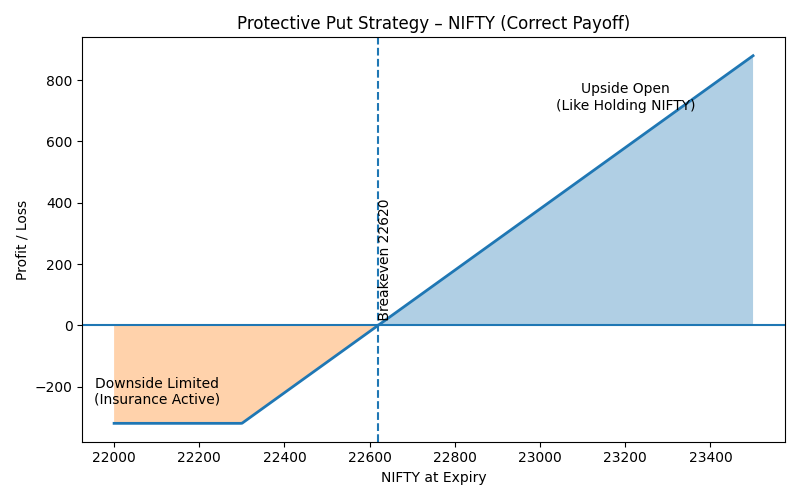
Profit and Loss Structure Explained Simply
• Upside remains open if NIFTY rises
• Downside is capped beyond the put strike
• Breakeven shifts upward due to premium paid
• Protection activates during sharp falls
This structure prioritizes safety over profit.
Impact of Time Decay on Protective Puts
Time decay works against the bought put.
• Protection costs money
• Premium reduces with time
• Best used selectively, not continuously
This is why protective puts should be planned carefully.
Expiry Week Behavior You Must Understand
During expiry week:
• Insurance value drops rapidly
• Protection weakens close to expiry
• Rolling may be required if risk persists
Many investors use monthly rather than weekly puts.
Risk Management Rules for Protective Put Strategy
Follow these rules strictly:
• Use protection only when necessary
• Avoid repeated unnecessary hedging
• Match put quantity to holding size
• Remove protection once risk passes
Hedging is a tool, not a habit.
Common Beginner Mistakes
• Buying protection after volatility spikes
• Using very short-dated puts
• Ignoring premium cost
• Treating hedging as profit strategy
Protective puts are about safety, not income.
Protective Put Strategy Summary
Quick Overview
Market view: Uncertain
Risk: Defined
Reward: Protection focused
Best used: Before volatile events
Worst used: Calm, low-volatility markets
This strategy is ideal for capital preservation.
Final Thought
The Protective Put Strategy teaches one of the most important lessons in trading.
Protecting capital is as important as growing it.
Used wisely, protective puts allow you to stay invested with confidence. Used blindly, they quietly drain returns.
Risk awareness defines professional traders.